Thursday, July 5, 2012

The Value of Nature


Driving west from St. Louis on Interstate 44 you encounter dozens of roadside advertisements for Meramec Caverns. Dubbed "America's Cave", it has been transformed over the years from its natural state in efforts to maximize its potential for profit as a tourist attraction. Travelers stop by and amazingly pay $19.50 apiece to "discover the treasures of time."

Meramec Caverns is rich in history. For instance, here is how the cavern's website describes some of the key events in the cavern's history.

The year was 1720 and Philipp Renault was lured to this area by Osage Indian legends. The Osage told Renault of a gigantic hole in the earth they would use for refuge when they were caught in extreme weather. The 'natives' also claimed along the walls of the cave were 'veins of glittering yellow metal', which captured the Frenchman's attention. 

Ha, I bet it did get his attention!

 As the boat reached the shore, Renault could immediately see what the Indians had spoken about. In front of the boat, just off the riverbank, the men of the Expedition party saw a gaping 50 feet wide and 20 feet high hole in the bluff. Philipp Renault had inadvertently discovered the largest cave West of the Mississippi. 

That's right... Renault DISCOVERED the largest cave West of the Mississippi. All this discovery required was a team of Osage guides who would take him directly to the cave and tell him exactly where to look.

 The 1890's brought a new era of human interaction to the cave. During that time, locals from Stanton, MO would hold 'cave parties' during summer months to avoid the extreme heat. Meramec Caverns was especially popular for these types of events, as a very large room lie just 300 feet inside the cave entrance. The room was large enough to accommodate big crowds, as well as a 50 foot by 50 foot dance floor in the center. This earned the room the nickname of the 'Ballroom'. Meramec Caverns, then known as Saltpeter Cave, was purchased in 1898 by Charles Ruepple, and he headed a dance committee along with other local men from Stanton. Dancing continued through the 1890's and spilled over into 1900, but it would be another 33 years before the most significant event in the cave's history.

The "most significant event in the cave's history"... can you guess what that is? Go ahead and take a guess. I bet you'll get this right!

Mr. Lester Dill's sole interest in the cave was to develop it into a show cave and allow it to be entertainment for the public. Charles was reluctant at first, but soon agreed to sell the cave to Les. Les changed the name from Saltpeter Cave to Meramec Caverns and quickly began promoting and offering cave tours to the public. 

Years later another room was discovered in the cave. This room contained artifacts that could be traced back to Jesse James. Thus, the cave was then advertised as "Jesse James' Hideout" and even more folks came out to gawk at the pools of water, stalagmites, and stalactites. Concerned this may not hold the average Joe's attention the cave owners modernized the cave with speakers and ambiance lighting. Now you can sit on benches and watch a patriotic light show flash across a drapery formation while listening to Kate Smith sing "God Bless America." I guess it really is America's Cave.

Here are some photos of this "natural" wonder. Tricia and I did visit the caverns on my twenty-first birthday. I felt like vomiting as soon as we left. These images, however, have been taken from a Google search.

Stalactites are bathed in strange hues.
 
While kind of cool to see, these lights - to me- cheapen the experience and play into an assumption that we can't find beauty and wonder in the natural world. Or at least, fewer and fewer can do this.
What cave experience is complete without neon tubing?

And, of course, what better way to celebrate your hour-and-a-half spent reconnecting with nature than to stop by the gift shop for a piece of rock that has been carved into the shape of an elephant?


 I wrote about a similar experience last month after returning from Oregon. With so much to love and feel inspired by during that trip I couldn't get past the fact that I had spent $20 for Harper and I to take an elevator underground to see a large group of sea lions sitting on a rock in what had been aptly named "Sea Lion Caves". As with Meramec Caverns, this really cool place had been purchased and turned into a cheesy tourist attraction. Nature, it seems, is nothing more than a commodity. An opportunity to charge people money to come flash a few pictures and buy a t-shirt. That is, if there is something relatively uncommon worth coming to see. 


But what if there are no vistas, waterfront access points, or high-interest wildlife nearby? What then? What is the value of that piece of nature? Unfortunately a few of our not-too-distant neighbors have found their own answer to this question. With one simple call they have reduced their land to a series of jagged stumps and piles of debris left behind by logging trucks and bulldozers. With large tracts of land sitting idly by, the owners decided to sell off the very things that made their land so special - the trees. And while I'm sure they have a good bit of extra spending money lining their pockets I can only hope, like the owners of such atrocities as Meramec Caverns and Sea Lion Caves, they feel some sense of remorse when they look out and see what they've done.


Tuesday, June 26, 2012

Last Child in the Woods - Pt. 1


The first ten or eleven years of my life was spent living in two different apartments just outside of Granite City, Illinois in a small village known as Pontoon Beach. Despite it's promising name, there was no actual beach. In fact, there was very little nature of any kind.  The majority of our play took place in shared green spaces that  were the equivalent of a large front lawn. However, there was a large vacant lot situated between our apartment building and a near-deserted strip mall that housed,among other things, a bar and a motorcycle showroom.

 The vacant lot was wooded and while not a thing of beauty it offered a tiny bit of nature to an otherwise developed area. My friends and I sometimes played in those woods. Among the trees, cigarette butts, and broken glass we'd occasionally find a turtle, but more often a toad or grasshopper. I wasn't much impressed by these animals. I was much more likely to be frightened of touching a frog than I was to go running home asking if I could keep it. I don't know how I came to be this way. What makes us afraid of harmless animals? Is this a learned response or is it due to a lack of experience in nature? I played outside pretty much every single day of the summer when I was little but my time was spent riding bicycles, playing baseball, and running around the neighborhood with friends. While I was definitely an outside kid I was not, by any stretch of the imagination, a nature kid.

I've been reading a book the past few days titled Last Child in the Woods: Saving Our Children from Nature-Deficit Disorder. In the book Richard Louv argues that exposure to nature is essential to our children's physical and emotional development. Not surprisingly, though, he finds that few kids these days spend much time at all outdoors - none-the-less in nature. Here are some of my favorite passages...

*  Today kids are aware of the global threats to the environment - but their physical contact, their intimacy with nature, is fading. That's exactly the opposite of how it was when I was a child.


*  A kid today can likely tell you about the Amazon rain forest - but not about the last time he or she explored the woods in solitude, or lay in a field listening to the wind and watching the clouds move.


*  How the young respond to nature, and how they raise their own children, will shape the configurations and conditions of our cities, homes - our daily lives.


*  [There is a] severance of the public and private mind from our food's origins...Few of us miss the more brutal aspects of raising food. For most young people, memory supplies no experience for comparison...In less than a half century, the culture has moved from a time when small family farms dominated the countryside to a transitional time when many suburban families' vegetable gardens provided little more than recreation, to the current age of shrink-wrapped, lab-produced food.


*  We can no longer assume a cultural core belief in the perfection of nature. To previous generations of children, few creations were as perfect or as beautiful as a tree. Now, researchers flood trees with genetic material taken from viruses and bacteria to make them grow faster, to create better wood products, or to enable trees to clean polluted soil...And the University of California promoted "birth control for trees," a genetically engineered method of creating a "eunuch-tree that spends more of it's energy making wood and not love." For baby boomers, such news is fascinating, strange, disturbing, To children growing up [today] such news is simply more hair on the dog - an assumed complexity.


*  The newly dominant type of [developed neighborhood]...offers fewer places for natural play than earlier suburbs...A few years after moving to Scripps Ranch, John Rick started reading articles in the community's  newsletter about the "illegal use" of open space. "Unlike where we had lived before, kids were actually out there running around in the trees, building forts, and playing with their imaginations," he recalls. "They were putting up bike ramps to make jumps. They were damming trickles of water to float boats. In other words, they were doing all the things we used to do as kids. They were creating for themselves all those memories that we cherish so fondly." And now it had to stop. "Somehow," says Rick, "that tree house was now a fire hazard. Or the 'dam' might cause severe flooding."


Authoritative adults from the Scripps Ranch Community Association chased kids away from a little pond near the public library, where children had fished for bluegills...In response to the tightened regulations, families erected basketball hoops. Young people moved their skateboard ramps to the foot of their driveways. But the community association reminded the residents that such activities violated the covenants they had signed when they bought their houses.


Down came the ramps and poles, and indoors went the kids.


 I can't agree more with arguments such as the fact so many parents state they want their kids to have less screen time yet they keep expanding their opportunities (phones, i-pads, Kindles, car video systems, etc) for watching. Louv writes "Quality of life isn't measured only by what we gain, but also by what we trade for it." I'm going to continue to read and think about all this. I'd like to use a future post to relate these ideas to things I've been noticing in my own community as well as considerations for my own parenting.

Thursday, June 14, 2012

On the Oregon Coast

Harper and I spent this past week on the Oregon coast with a group of marine biologists who were working to better understand the effects of climate change. While there we were able to help collect an assortment of data on Pisaster sea stars and dissect mussels. It was really very interesting. One day as we drove down the coastal highway toward our field site I saw a group of tourists pulled over at the side of the road snapping photos of the rocky surf. Knowing they'd soon climb back into their cars and head off to some other spot without ever really knowing this one, I thought about  how fortunate we were to have the opportunity to become a part of of this little swatch of coastline - no matter how briefly.

At the end of the week we flew home and I have now begun to think about what this experience will mean to me and my students next year in the classroom. That was the point - to live and work alongside real scientists in hopes of rethinking the ways in which we go about teaching things like scientific inquiry, animals, or geology. Many of us came back home with more questions than answers but that is part of the process.


This was "home" for Harper and I in Oregon. It was located just a few hundred yards from the ocean.
This was the second house where a few other teachers were staying along with the team of marine biologists. The yard, like most of the other houses in this neighborhood, was full of tall beach grass. No lawn mowers!
To the north we could see the mountains.

The crew from the  Helmuth Lab arrived two days before us. They spent that time dissecting hundreds of mussels they had collected from the tide pools. Here they have a collection of mussel gonads that were being shipped to a lab in Italy.
When we arrived at the field site each morning we would pull on our rain gear.
The site we worked at was named Strawberry Field. There was a high wall which dropped down into a band of sand and basalt. The tide pools were located just outside the frame of this picture, to the right.
The site was a little tricky to reach due to all the rock hopping we had to do. This was made more difficult by the task of carrying in the gear. However, there were fifteen of us and everyone was happy to pitch in.
The experiment we were supposed to be working on did not pan out. We were going to be collecting the heart rates of mussels located throughout the tide pools. However, the sensor was not cooperating so we were reassigned.
This is a Pisaster sea star. They are much harder than you would expect. Their backs feel like a course rock.
The Pisasters spend their days eating mussels. To do this they pry open the shell,  release their stomach, and digest the mussel right inside the shell. In this picture you can see a mussel being eaten by the Pisaster. They can eat entire beds of mussels. You can see their tube feet latching on to the mussel.
Pisasters can be purple or orange. Once we developed an eye for seeing them we found they were everywhere.
Anemones sit at the bottom of the tide pools waiting for something to drop into their center. When this happens, say a small mussel drops into the water, the anemone closes around it and eats it. If you put your finger in the center of the anemone it will close. It feels a bit sticky but poses no danger to a human. No fingers were lost on this trip.
One of our jobs was to establish a transect (a fixed path) where we would observe, measure, and describe the location of Pisasters in relation to the pools, waves, and sun. We would then remove the Pisasters and calculate the average length of their arms.
Two of the  measuring tools we used were a laser level and measuring stick. This helped to establish how high each Pisaster was above the water line.The measurements we collected with this gear were a bit crude but the team would be able to use this data to more accurately calculate the measurements later using a more sophisticated tool that incorporates GPS technology.
When we were missing a much needed tool (in this case, a measuring tape) we would improvise. The girls from the Helmuth lab made us makeshift rulers from waterproof paper to use in measuring the lengths of the sea star's legs. This data will be recalculated into standard units back in the lab.
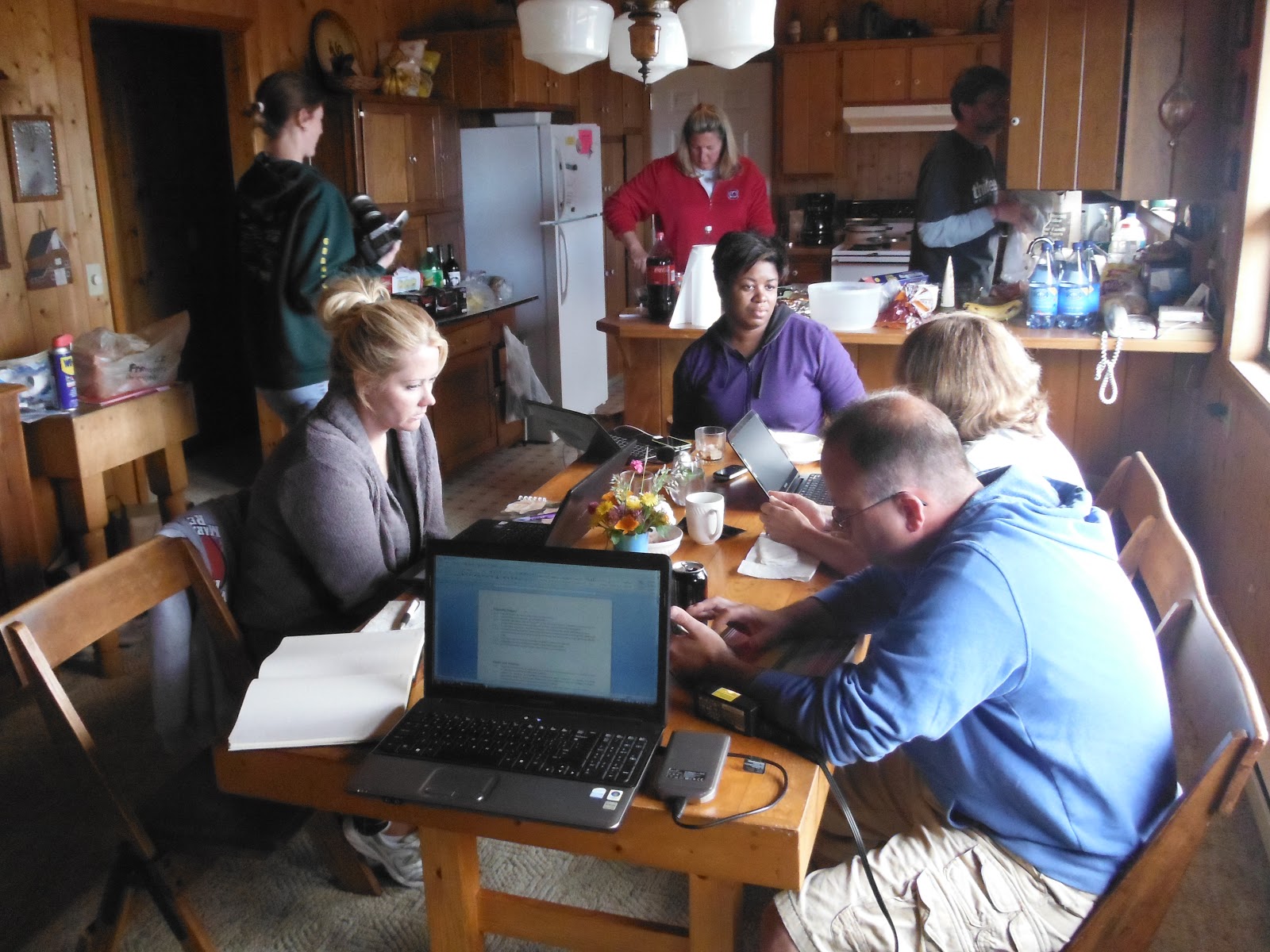
Careful recording of data was an important part of all our field work. When we would return to the houses the teachers were often free to eat, rest, and talk while the scientists kept working - entering data into their computers. All this data will take quite some time to analyze back at USC.
We were extremely thankful for the enthusiasm and patience of the scientists. We asked lots of questions and they answered every one.
Another of our tasks was to help dissect mussels. We harvested the gills, aductors, and mantles. Each was carefully removed, wrapped in tin foil, and put in a cooler with dry ice. These were shipped back to their lab at USC. The dissections were especially difficult with cold hands.
Harper spent time exploring the tide pools with a friend. They found all sorts of animals.
This is a small crab they found crawling along the rim of one of the tide pools.
She wasn't too sure about holding the sea star but reached out and grabbed it anyway. By the end of the first day she was scooping up everything she could catch.
Stared down by a crab.
There weren't a whole lot of sea urchins at Strawberry Field but Harper did manage to find one or two.
Of course, part of the fun is just climbing up and down all those rocks.
Some mornings were colder than others. On this particular day it was raining and very cold. We rushed to get in our work before the thunderstorms rolled in. We just barely made it.
Another job was to remove tube feet from the Pisasters and place them into small tubes to be tested back at the lab. These tube feet look like small straws. The Pisasters use them to hold on to the rock face. We were assured they grow back and it feels no worse to the Pisasters than a haircut feels to us. While I don't know if this is true or not I do know that sea stars don't exactly offer up those tube feet to the forceps and scissors. This job really took some patience and a game plan.
Before collecting the tube feet we took the Pisasters' temperature by probing each of their arms and then finding the mean (aka average).
All this data was called out and someone would record it into the field journals. They were made of waterproof paper.
The tide pools ranged from the tiniest of puddles to rather deep pools. The surrounding rocks at Strawberry Hill were sometimes completely covered in mussels, such as in this picture. We did our best to avoid walking on the mussels but that was often impossible.
We finished each day around noon or so and then had the rest of the day to ourselves. Harper began keeping notes for a blog post of her own.
There were a total of three kids on the trip. One afternoon I  took them on a walk to the beach to play. The water was frigid but they still enjoyed splashing around.
The beach was littered with driftwood from Japan. One day we even found a deal seal on the beach. It was a sad sight.
Flower lining the path to the beach.
Back at the house the teachers shared their experiences and thought about how this experience of living the life of a scientist would change the way we taught the students in our classroom. We were all looking for ways to engage our kids in authentic scientific pursuits.
Some of this debriefing also took place in more informal settings. We were all so excited by all we were learning and experiencing.
Our final day was at a different site - Boiler Bay. This site was beautiful but not as interesting. The water splashing up into the rocks was not so nutrient rich as it was back in Strawberry Fields. For this reason there were far fewer, and less developed, mussels. Fewer mussels meant fewer sea stars. However, we did see some sea snails and lots of urchins.
Harper's favorite part of Boiler Bay was the waterfall. She pulled off her rain gear and jumped right in. Twenty minutes later she was shivering back in the van. It was cold!
None of these sites were easy to access. Boiler Bay was the most difficult. We had to navigate a steep descent down a series of very large rocks.
These cages were left by other teams of scientists as part of long-term data collection. Our team swapped out "robo-mussels" that were designed to collect data over the next year.These were glued down to the rock surface alongside the other real mussels.
There was a nearby cave with lots of sea lions inside. This piece of nature cost us $12 per person to see. And, of course, we had to walk through a gift shop to reach the cave. How sickening. The very next day we came upon about 60 seals sun bathing on the beach. They let us walk within about 15 feet from them. We just sat there in awe of being so close. And we didn't even have to buy a t-shirt or pay admission. Go figure.