Thursday, June 14, 2012

On the Oregon Coast

Harper and I spent this past week on the Oregon coast with a group of marine biologists who were working to better understand the effects of climate change. While there we were able to help collect an assortment of data on Pisaster sea stars and dissect mussels. It was really very interesting. One day as we drove down the coastal highway toward our field site I saw a group of tourists pulled over at the side of the road snapping photos of the rocky surf. Knowing they'd soon climb back into their cars and head off to some other spot without ever really knowing this one, I thought about  how fortunate we were to have the opportunity to become a part of of this little swatch of coastline - no matter how briefly.

At the end of the week we flew home and I have now begun to think about what this experience will mean to me and my students next year in the classroom. That was the point - to live and work alongside real scientists in hopes of rethinking the ways in which we go about teaching things like scientific inquiry, animals, or geology. Many of us came back home with more questions than answers but that is part of the process.


This was "home" for Harper and I in Oregon. It was located just a few hundred yards from the ocean.
This was the second house where a few other teachers were staying along with the team of marine biologists. The yard, like most of the other houses in this neighborhood, was full of tall beach grass. No lawn mowers!
To the north we could see the mountains.

The crew from the  Helmuth Lab arrived two days before us. They spent that time dissecting hundreds of mussels they had collected from the tide pools. Here they have a collection of mussel gonads that were being shipped to a lab in Italy.
When we arrived at the field site each morning we would pull on our rain gear.
The site we worked at was named Strawberry Field. There was a high wall which dropped down into a band of sand and basalt. The tide pools were located just outside the frame of this picture, to the right.
The site was a little tricky to reach due to all the rock hopping we had to do. This was made more difficult by the task of carrying in the gear. However, there were fifteen of us and everyone was happy to pitch in.
The experiment we were supposed to be working on did not pan out. We were going to be collecting the heart rates of mussels located throughout the tide pools. However, the sensor was not cooperating so we were reassigned.
This is a Pisaster sea star. They are much harder than you would expect. Their backs feel like a course rock.
The Pisasters spend their days eating mussels. To do this they pry open the shell,  release their stomach, and digest the mussel right inside the shell. In this picture you can see a mussel being eaten by the Pisaster. They can eat entire beds of mussels. You can see their tube feet latching on to the mussel.
Pisasters can be purple or orange. Once we developed an eye for seeing them we found they were everywhere.
Anemones sit at the bottom of the tide pools waiting for something to drop into their center. When this happens, say a small mussel drops into the water, the anemone closes around it and eats it. If you put your finger in the center of the anemone it will close. It feels a bit sticky but poses no danger to a human. No fingers were lost on this trip.
One of our jobs was to establish a transect (a fixed path) where we would observe, measure, and describe the location of Pisasters in relation to the pools, waves, and sun. We would then remove the Pisasters and calculate the average length of their arms.
Two of the  measuring tools we used were a laser level and measuring stick. This helped to establish how high each Pisaster was above the water line.The measurements we collected with this gear were a bit crude but the team would be able to use this data to more accurately calculate the measurements later using a more sophisticated tool that incorporates GPS technology.
When we were missing a much needed tool (in this case, a measuring tape) we would improvise. The girls from the Helmuth lab made us makeshift rulers from waterproof paper to use in measuring the lengths of the sea star's legs. This data will be recalculated into standard units back in the lab.
Careful recording of data was an important part of all our field work. When we would return to the houses the teachers were often free to eat, rest, and talk while the scientists kept working - entering data into their computers. All this data will take quite some time to analyze back at USC.
We were extremely thankful for the enthusiasm and patience of the scientists. We asked lots of questions and they answered every one.
Another of our tasks was to help dissect mussels. We harvested the gills, aductors, and mantles. Each was carefully removed, wrapped in tin foil, and put in a cooler with dry ice. These were shipped back to their lab at USC. The dissections were especially difficult with cold hands.
Harper spent time exploring the tide pools with a friend. They found all sorts of animals.
This is a small crab they found crawling along the rim of one of the tide pools.
She wasn't too sure about holding the sea star but reached out and grabbed it anyway. By the end of the first day she was scooping up everything she could catch.
Stared down by a crab.
There weren't a whole lot of sea urchins at Strawberry Field but Harper did manage to find one or two.
Of course, part of the fun is just climbing up and down all those rocks.
Some mornings were colder than others. On this particular day it was raining and very cold. We rushed to get in our work before the thunderstorms rolled in. We just barely made it.
Another job was to remove tube feet from the Pisasters and place them into small tubes to be tested back at the lab. These tube feet look like small straws. The Pisasters use them to hold on to the rock face. We were assured they grow back and it feels no worse to the Pisasters than a haircut feels to us. While I don't know if this is true or not I do know that sea stars don't exactly offer up those tube feet to the forceps and scissors. This job really took some patience and a game plan.
Before collecting the tube feet we took the Pisasters' temperature by probing each of their arms and then finding the mean (aka average).
All this data was called out and someone would record it into the field journals. They were made of waterproof paper.
The tide pools ranged from the tiniest of puddles to rather deep pools. The surrounding rocks at Strawberry Hill were sometimes completely covered in mussels, such as in this picture. We did our best to avoid walking on the mussels but that was often impossible.
We finished each day around noon or so and then had the rest of the day to ourselves. Harper began keeping notes for a blog post of her own.
There were a total of three kids on the trip. One afternoon I  took them on a walk to the beach to play. The water was frigid but they still enjoyed splashing around.
The beach was littered with driftwood from Japan. One day we even found a deal seal on the beach. It was a sad sight.
Flower lining the path to the beach.
Back at the house the teachers shared their experiences and thought about how this experience of living the life of a scientist would change the way we taught the students in our classroom. We were all looking for ways to engage our kids in authentic scientific pursuits.
Some of this debriefing also took place in more informal settings. We were all so excited by all we were learning and experiencing.
Our final day was at a different site - Boiler Bay. This site was beautiful but not as interesting. The water splashing up into the rocks was not so nutrient rich as it was back in Strawberry Fields. For this reason there were far fewer, and less developed, mussels. Fewer mussels meant fewer sea stars. However, we did see some sea snails and lots of urchins.
Harper's favorite part of Boiler Bay was the waterfall. She pulled off her rain gear and jumped right in. Twenty minutes later she was shivering back in the van. It was cold!
None of these sites were easy to access. Boiler Bay was the most difficult. We had to navigate a steep descent down a series of very large rocks.
These cages were left by other teams of scientists as part of long-term data collection. Our team swapped out "robo-mussels" that were designed to collect data over the next year.These were glued down to the rock surface alongside the other real mussels.
There was a nearby cave with lots of sea lions inside. This piece of nature cost us $12 per person to see. And, of course, we had to walk through a gift shop to reach the cave. How sickening. The very next day we came upon about 60 seals sun bathing on the beach. They let us walk within about 15 feet from them. We just sat there in awe of being so close. And we didn't even have to buy a t-shirt or pay admission. Go figure.

Monday, May 28, 2012

What's in a Name?

A few years ago Tricia gave me an Appalachian Trail Conservancy membership for my birthday. As part of this membership I receive a monthly magazine, AT Journeys . Last month's magazine listed all the hikers who managed to finish the trail last year. 500 of them were thru-hikers (finishing in one year) and 120 were section hikers (taking a number of years to bit and piece the trail together). Either way, they each walked more than 2,100 miles which is awfully impressive.

Hikers on the trail do not go by their given names. Rather, each receives (or gives themselves) a trail name. At first this seems a little strange but with time they grow used to being called Lego or Chuckwagon. Many times the majority of the hikers they encounter never know their real names - just these bizarre aliases.

Last year when the boys and I were on the trail over spring break I heard someone receive their trail name. It was just past sun-up and I was lying in my sleeping bag and listening to the sounds of the early risers break down their tents and pack up their gear. There was an older hiker named Roger who had been going by the name of "Mr. Rogers" but had confessed the night before that he really didn't like it all that much because it was too obvious. A young girl came over to him as he packed up his stuff and told him she had been thinking about his name when she went to bed the night before and came up with something she thought he'd like.

"How about Trolley Stop?" she asked. "You know, like on Mr. Rogers. He would sit on that little bench and the trolley would come and take everyone to the fantasy land. That was always my favorite part of the show."

Roger thought it over and decided he liked it. For the next five months everyone he met came to know him as "Trolly Stop." He packed up and left before the boys and I even made it out of our tents so we never did see him again. However, it was exciting to find his name in the magazine and see that he had completed his hike. Turns out people off the trail know him as Roger Gorrey. Go figure.

Here is a list of other interesting trail names I found on the list. I've tried to group them by category.

Jobs/Schooling - Not so surprising, most people shy away from names that reconnect them to the workforce. However, I'm glad to see that one of the few who do are in education!

Professor (Does this sound snotty to you? Maybe it's a reference to Gilligan's Island, though.)
Grad School
Engineer

Interests - Right or wrong, each of these kind of gives a mental image of what they might look like.

Bookhawk
Guinness
Six String
P.C.
Kayak
Right-Click
Portrait
Whiskey

Cliche - Some of these names get used over and again. Others are just too obvious.

Caveman
Spartan
Tarzan
Frodo (Historically, this is among the most popular trail names. That may tell you a bit about the folks you see out there.)

Animals - Do you suppose these are given because the hiker's appearance shares a likeness? Are there any animals you'd care to look like?

Grasshopper
Chickadee
Loon
Squirrel
Moose
Shark
Chimp
Billygoat (The boys and I met Billygoat about 70 miles into his hike. We stopped and chatted for about five minutes or so. He was a really nice guy and hiked incredibly fast.)

Movies/Books - I'm certain these names are self-selected before hitting the trail. Except maybe "Buscemi". Surely no one would do that to themselves.

O.B.1
Odyssa (She set the AT record for fastest hike - averaging more than 50 miles per day. We missed crossing paths with her by two days just south of the entrance into Smokey Mountain National Park.)
Muggle
Ewok
Buscemi
Griswald
Firefly
True Grit
Hobbit

Superheroes - These seem pretty lame. If I came across any of these hikers I'd either speed up or slow down.

Boy Wonder
Cape Crusader
Captain America

Pace/Perseverance on the Trail - Names related the act of walking are super-common.

Little Engine
Pacemaker
WalkAbout
Shuffle
Steps
Inchworm
Meander
Wanderer
Slo Jo
Truckin'
Stride

Hardships/Tribulations on the Trail- You have to love someone who can find humor in bad situations.

Black Foot
Rain Gear
Turn Around
Bum Knee
Hospital Guy (I really like this name. It's original and makes you want to ask the inevitable question...)
Oops
Whoop!

Forewarning to Other Hikers - These are hikers who should be avoided at all costs.

Chainsaw (Snores at night)
Ass Trumpet (Passes deadly gas at night)
Stinkbug (Stinks even worse than the typical hiker - which is saying a lot)
Dogbreath (Thru-hikers DO bring toothbrushes)
Whistler (Everyone's least favorite morning hiker)

Food/Hunger Related - To provide a constant reminder of the limited food choices on the trail.

Sweet Tea
Oatmeal
AYCE (All-You-Can-Eat. These are the favorite restaurants among hikers hitching into town.)
Chowhound
Vegan
Mountain Dew

Self-Deprecating - The underdogs!

Low Expectations
Old Fat Dad
Foureyes
Putz

Tells a Bit About One's Personality/Self- Wouldn't parties be easier if everyone had one of these? Remember Close Talker?

Maniac
Witticism (This name would seem to put a lot of pressure on its owner.)
Checklist (This sadly sounds like it could be me.)
Optimist
No Worries
Happy Jack
Jerryatric
Tattoo

Probably Has an Accompanying Story - The best category.

Snake Farm
Lady Pants
Kerosene Charlie
Hand Me Down
Mothership
Spork
Barnacle

Hiking Duos Whose Names Play Off One Another- This is essentially the equivalent of those couples who dress alike.  They disgust me!

Hansel and Gretel
Oompa and Loompa
PB and J 

Sunday, May 13, 2012

Eat Fresh


This spring we joined a CSA (Community Supported Agriculture) farm. We paid up front for a share that will provide us with a weekly box of seasonal veggies that are locally grown. The benefits for the farmer are: (1) they get to market their crops early in the season, (2) they receive payments up front rather than at the end, and (3) they have the opportunity to connect with the families who purchase and eat their food. The benefits for the consumers are: (1) getting really fresh food, (2) supporting local farms, (3) reducing their carbon footprint, (4) knowing where their food comes from and how it is grown, and (5) trying new foods.

For thirteen weeks we will receive a big box of produce from Pinckney Farm. They deliver their boxes around the state. We pick ours up each Thursday afternoon from a garden center about three or four miles away from my school. Shares are offered in various sizes- from small to extra-large. Given that we have a family of seven to feed each night we went with the extra-large portion. The box is roughly the size of a recycle bin. We bring it home full of veggies each Thursday and then trade our box in the following week.

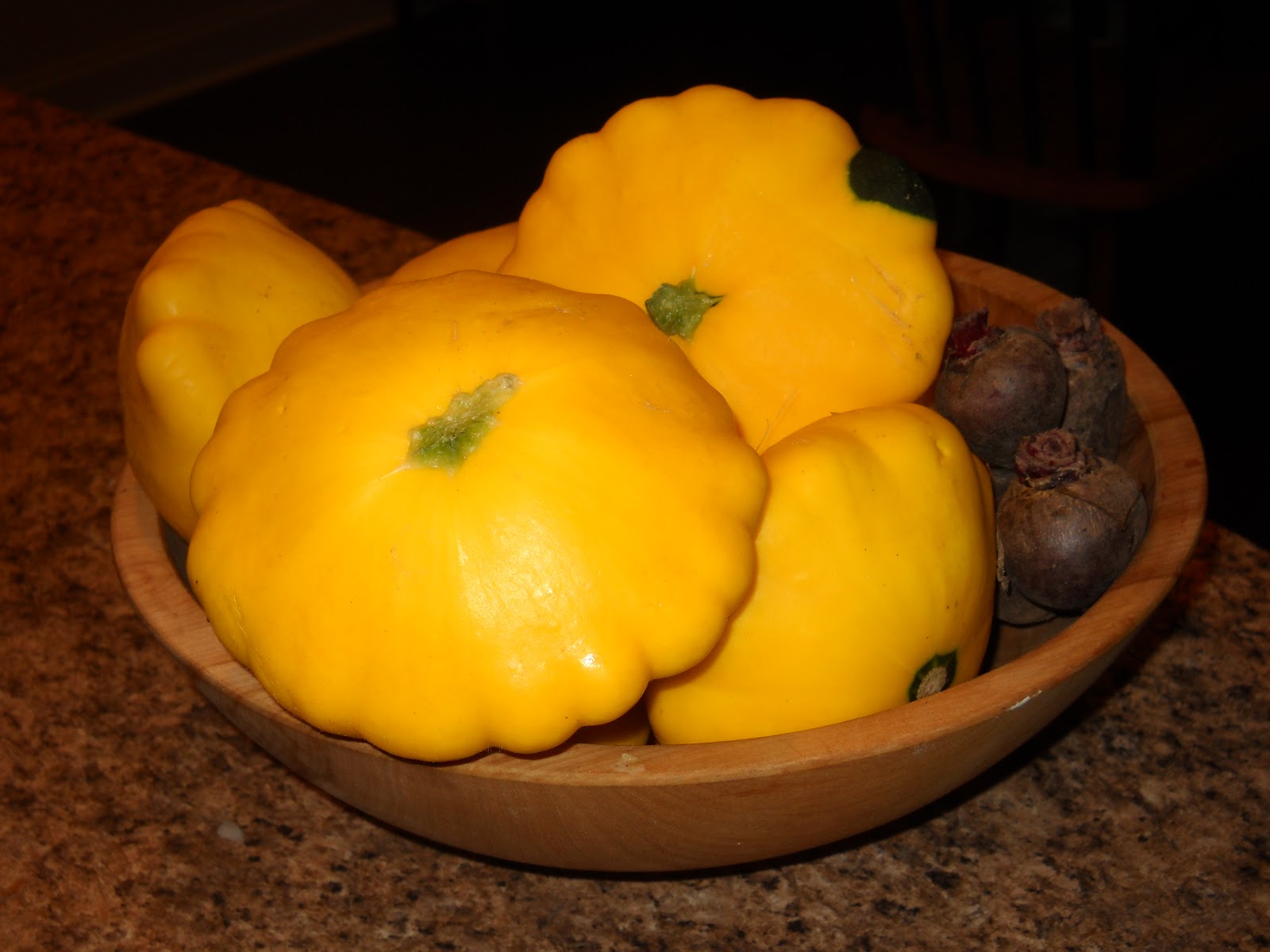
The first few weeks had a lot of greens, cabbage, cauliflower, and squash. Actually, loads of squash. I never knew there were so many different types. One Ball squash. Eight Ball squash. Yellow squash. Patty Pan squash (pictured at right with beets). We have never been squash eaters so this has really challenged us to find recipes we like. Tricia steamed the patty pans last week, cut off the tops and scooped out the insides, and filled the remaining "squash bowls" with a mixture of rice, squash, and cheese. It was good and a lot of fun to look at.

These are cool weather crops. As the weather turns warmer the contents of our box will change. I'll be excited to see the sweet corn, potatoes, string beans, carrots, and tomatoes find their way into the box. In the meantime, we're learning how to make pickles, stir-fry cabbage, and freeze surplus squash in hopes of adding it to our fall and winter soups. This is quite a leap for Tricia and I provided there was a day not all that long ago when we only ate two or three different types of vegetables.

Here's a look at some of the meals we've been enjoying...

Salad greens and onions came from the farm. Tomatoes and carrots from the grocery store.
We have MANY jars of strawberry jelly in the freezer. It tastes way better than anything Smuckers makes.
Dressed squash, zucchini, and grape tomatoes before hitting the grill. This has been our favorite so far.
Making our own pickles with cucumber, vinegar, mint, and cilantro.
What do you do with two huge heads of cabbage each week? Make lots of slaw!
I've learned to like cauliflower. When seasoned correctly, it's really very good.

Sunday, May 6, 2012

The Compost Crew

We've been flying right through spring, heading toward an early summer. Or maybe there is no spring in South Carolina. It seems the daily highs somehow skipped the 70's and jumped right into the high 80s and low 90s. I'm not complaining, though. I love throwing on a pair of shorts and a t-shirt each morning and not having to worry about whether or not it'll be cool at recess. It never is.

I used the shift into warmer weather to sort out our compost a few weeks back. We keep two compost piles in the back. One is the traditional sort where we layer food scraps with other organic material. The other is a vermicompost which consists of a couple thousand red wiggler worms, shredded newspaper, and a few cups of weekly food scraps.

We used to temporarily keep our food scraps in an old margarine tub on the kitchen counter until someone took the initiative to get them outside. However, it didn't take long for the fruit flies to find their way in and before we knew it our house was full of what must have been hundreds, if not thousands, of tiny flies. They were everywhere. We eventually had to start taking our compost straight outside. This was effective but a hassle.

A few months ago Tricia's parents sent us a countertop compost crock. It is aerated by tiny holes in the lid. A small filter fits into the lid to control the odor as well as to keep out unwanted guests. We've had very few flies since making the switch.

This has been our first real attempt at composting. Much of what we've been doing has been trial-and-error. I've tried doing research to help improve our chances of success but much of what I read contradicts other sources and some of this stuff has too much scientific jargon for my present level of understanding. So, basically we've decided to collect our compost-friendly food waste and dump it all into a pile with some leaves and ash and wait to see what happens. There are worse places to start.

The traditional compost seemed to be a bit slimy at times. I suspect this was due to too much food matter (green) and not enough carbon (brown) matter. I could have kept the compost too wet, as well. Either way, when I pulled the plastic housing off the pile and spread it out it looked as though everything turned out pretty well. Pulling the pile apart with a shovel, I found that nature had produced a heap of dark black soil from all that stuff I had thrown in there over the past eight months. We immediately used it to plant a few pots of herbs and vegetables and the rest went into a large storage bin to be used in the future.

The vermicompost was a little more labor-intensive. The bin had to be dumped out onto a large tarp in the sun. There was a pile of sticky black soil (aka, worm poo). The worms, exposed to the sun, immediately made their way down into the pile. We scooped up the top later and placed it into another bin. This exposed the worms again so they dug even deeper. Again we scooped off the top layer. On and on this process continued until we had separated the soil from the worms.

Here are the worms doing their job - eating our trash and making it into soil.
Everything is dumped out into the sun. The worms hate this part.
The soil is really wet and sticky. It was hard to get any evaporation during the winter months.
Sorting it all out. We found many "balls" of worms in there.
This is the final result - super rich soil.
Shredding newspaper to start all over again. The worms will eat this paper in addition to the food scraps.
We used our compost to plant basil, cilantro, tomatoes, and a few other things.
We also used it to plant some Carolina Jessamine around our screened porch. This is watered with the rain barrel.
The rest of the vermicompost is being brewed into "worm tea."
Here you see the bag of vermicompost sitting in the rainwater. An aquarium pump and air stones work to circulate the water. The resulting tea will help keep our plants really strong and healthy.


I'd love to go through this whole process next year with my class at school. It'd be fun to compost our food, sort the soil, brew it, and then conduct some experiments to see what benefits, if any, the worm tea offers. Taller plants? Greener plants? Stronger root systems? Who knows. If nothing else I can guarantee such a project would save many pounds of food from being hauled away by the gas guzzling trash truck.

Sunday, April 22, 2012

The Bird

When Tricia, the kids, and I first came to South Carolina we moved into a new-construction home in the suburbs of Northeast Columbia. While our community had thousands of families, the street we built on was nowhere near full capacity. In fact, there were no other houses within five or six lots in any direction. It was nice being surrounded by all those trees. We were nestled back in the woods. That is until the lots started selling and the bulldozers began to knock down trees by the hundreds.

It was sad to see. In just a few hours a crew of three or four guys could reduce a quarter acre of trees to a sandy lot littered with upturned roots and spent Gatorade bottles. You always knew when this was set to happen because someone would come out and tag the property for clearing. I know trees do not have feelings but it was still a bit heartbreaking to sit on the porch and look at all those trees knowing what was soon to come.

A few times I drug a shovel and a collection of five-gallon buckets over and tried to save the smallest of those trees. I'd dig and dig and dig. I quickly found out that the tap root of a pine tree grows straight down into the ground and is just about as long as the tree is tall. Still, I wiped the sweat out of my eyes and worked until I had a tree in each bucket to bring back home.

I tried to transplant the first batch of trees into our backyard. They died. I tried another batch. They died, too. I took the next batch to school and set them in the courtyard just outside my classroom door. My class and I made it our duty to save these trees.

Hey, you're like the Lorax. You speak for the trees! my teammate said. Then she laughed at the sight of those three sad trees - all brown and looking as though they might make great kindling.  

Except that instead of saving the trees you seem to kill them! she added.

She was right. All I accomplished was prolonging the agony. At least the bulldozer was swift.

These failed attempts reminded me of the time when I was seven or eight and found a small blue robin egg on the ground. I brought it into my bedroom and tried to keep it warm under my pillow until I could create a box to keep it in. I filled the box with an assortment of t-shirts and grass. I carefully placed the egg in the box and then set the box under a small desk lamp, turned it on, and waited.

Nothing.

I waited for a week or two but there was never so much as a small wiggle. When I had given up hope that my baby bird would emerge I cracked open the egg to see what was inside. It just a bunch of gloop (if that's even a word). No legs, no wings, no beak. I had failed.

This all came back to me yesterday as I nearly killed a couple of baby birds whose mother had made a nest atop one of the pillars on our front porch. A neighbor mentioned to my mom that sometimes a snake will come out of the woods, climb up the pillar, and eat the birds. Thinking I'd move the nest before the bird had a chance to lay eggs in it, I went out with a broom serve my eviction notice.

I began by banging the broom against the pillar to see if a bird would fly out. It did not. I did it a few more times waiting to hear any small chirps of fear. There were none. So I carefully scooped the nest down onto the flat side of the broom bristles and set it in the yard. And that's when I heard it.

A small chirp.

I went and grabbed a pair of gardening gloves and tried to sort through the collection of grass and twigs - hoping to find nothing. Of course, though, I did. A tiny bird - with a coat of brown and black fuzz on its back - jumped from the crumpled nest and hid beneath a small clump of grass. I jumped back and called out a few choice words. I had really hoped I wasn't going to find anything in that nest.

About this time the mother came back and, not aware of what had happened, perched atop the pillar with a worm hanging out of her mouth. She had come back to feed her baby and found her entire home and family missing. I felt terrible. Uncomfortable by our presence she flew up to the roof of the house to try to make sense of what was happening.

With the help of my mom and the two boys I scooped the nest into a small plastic cereal bowl (to keep it together) and then went about trying to catch the baby bird in a dustpan. I wasn't sure if it was true that if you touch a baby bird with your hands its mother will abandon it but I wasn't willing to risk it. After many attempts (in which it jumped out of the dustpan) I finally got the baby bird into its nest. However, just as I placed it back on top of the pillar the bird jumped out of the nest and took a nosedive in the small crack between the house and the pillar. I used a small stick to slide it out and then put it back into its nest. At that point we all ran inside not wanting to know what would happen next. There was nothing else we could do.

When I woke up this morning, after listening to the many storms roll in and out through the night, I looked out the front window to see if the nest was still up there. It was. Within a few moments the mother bird came swooping in with a worm in her mouth and hopped up into the nest.

It worked.

The mother bird is on the left warning me to not to do this again!